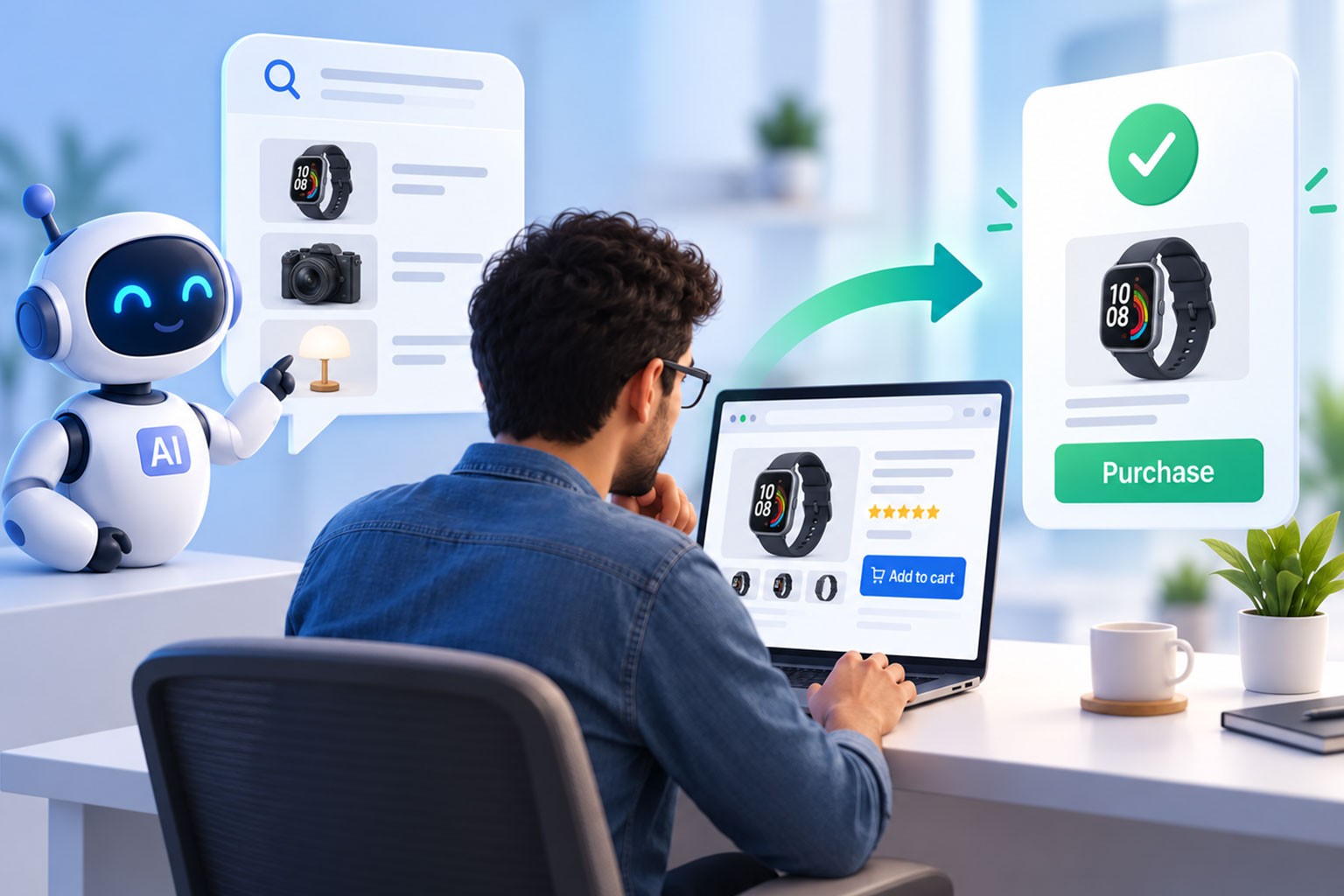
Something quiet is changing about how people shop online, and most business owners have not noticed yet. Instead of opening five browser tabs to compare a jacket or a standing desk, a growing number of shoppers now ask an AI assistant to do the legwork. The assistant reads the reviews, checks the prices, weighs the shipping options, and hands back a short answer. In some cases it can even complete the purchase.
That behavior has a name now. It is called agentic commerce, and the holiday 2026 season is shaping up to be its first real test at scale.
What is agentic commerce?
Agentic commerce is online buying where an AI agent handles part or all of the shopping process for a person. The agent can search across stores, compare products and prices, apply the shopper’s preferences, and in some setups place the order and authorize payment. The human sets the goal, and the software does the searching, filtering, and sometimes the checkout.
Think of it as the difference between a search engine and a personal shopper. A search engine hands you ten links and lets you sort them out. An agent hands you a recommendation, and increasingly, a completed cart.
The data that made this real
On September 15, 2026, PYMNTS Intelligence released survey results that put numbers behind the hype. The study drew on 2,061 US consumers and 60 US retail merchants, and a few figures stand out.
Among shoppers who already use AI to help them buy, 46 percent said they used it to find the best price or deal. That is the headline behavior: AI agents are becoming price-and-deal engines. More striking for anyone who runs a website, 53 percent of respondents said a lower price could pull them away from a major marketplace and toward buying directly from a brand’s own site. And 93 percent said they want AI tools that save time, protect their choices, and pause before making a big decision, which tells you shoppers want help, not a machine that spends their money without asking.
The merchant side is more cautious. Only 28 percent of the retailers surveyed said they would hand an AI agent their full product catalog on the same terms they offer other sales channels. Another 33 percent would share their full range but with different prices, promotions, or delivery options for agents, and 28 percent would limit agents to a selected set of products. Trust is the sticking point: 93 percent of merchants felt the AI or agent provider, not the merchant, should cover the loss when an agent makes the wrong choice, and 80 percent expect providers to verify an agent’s authority before a transaction goes through.
The clearest takeaway from the report: AI is very good at the discovery and price-comparison stage, and the checkout and payment-authorization stage is still the hard part.
How we got here
Agentic commerce did not appear overnight. OpenAI launched a feature called Instant Checkout inside ChatGPT in September 2025, letting people buy from certain US sellers without leaving the chat, and built an open Agentic Commerce Protocol with Stripe to standardize how agents and stores talk to each other. That first checkout version was shelved in March 2026 because it was not flexible enough, and OpenAI shifted its energy toward product discovery, according to reporting from Exploding Topics.
Perplexity has moved along a similar path, pairing shopping features with payment partners so users can find and buy products inside the assistant, with connections to platforms like Shopify and BigCommerce. Google has entered the space with its own commerce protocol work as well, as CNBC reported in January 2026. The pattern across all of them is the same: the discovery experience is maturing fast, and the payment plumbing is being built out piece by piece.
You do not need to track every protocol to get the point. The front door to your store is no longer only a search results page or a social feed. It is increasingly an AI assistant that a customer trusts to filter the noise.
What this actually means for your business
Here is the part worth slowing down for. If AI agents are becoming the shoppers’ research layer, then the businesses that win are the ones an agent can find, understand, and trust. That is not a marketplace-only game. Remember the 53 percent who said a better price would move them from a marketplace to a brand’s own site. Your website can be the destination an agent recommends, if it gives an agent what it needs.
That reframes a few priorities.
- Your product data has to be clean and machine-readable.
- Agents lean on structured information: clear titles, accurate prices, availability, specifications, shipping details, and reviews. Vague product pages that look fine to a human but hide the details in an image or a PDF are invisible to an agent. Structured data (schema markup) and well-organized product pages are no longer a nice-to-have.
- Your reviews and reputation carry more weight, not less.
- When an agent compares options, social proof is one of the signals it weighs. Genuine reviews, ratings, and a consistent presence across the web feed the recommendation.
- Speed and clarity at checkout matter more than ever.
- Agents surface options, but people still make the final call, and they bail when the last few steps are clumsy. A slow, confusing, or distrust-inducing checkout undoes all the discovery work an agent did on your behalf.
- Owned channels become your insurance policy.
- When AI drives the first discovery, the businesses that hold on to those customers are the ones with strong email and SMS relationships. If an agent sends someone your way once, your job is to make sure the next purchase does not need an intermediary at all.
Is this hype or a real shift?
Honest answer: both, depending on the timeframe. The share of purchases fully completed by an agent today is still small, and the PYMNTS data shows merchants are wary and shoppers want guardrails. Anyone promising that agents will run your entire funnel by December is overselling it.
But the discovery behavior is real and growing. People are already asking AI what to buy. The stores that prepare their data, reputation, and checkout now will be the ones agents can actually recommend when the volume arrives. The businesses that wait will be learning the rules during their busiest season, which is the worst time to learn anything.
A practical starting checklist
If you want to get ready without boiling the ocean, start here.
- Audit your top 20 product or service pages. Are the price, availability, and key details in plain text, not locked inside an image?
- Add or fix structured data on those pages so machines can read them.
- Make sure your business information (name, category, offerings, location if relevant) is consistent everywhere it appears online.
- Test your checkout or inquiry flow on a phone and count the steps. Cut the ones you do not need.
- Build or strengthen an email and SMS list so an AI-driven first purchase can turn into a direct relationship.
None of that is exotic. It is good ecommerce hygiene, pointed at a new kind of reader.
If getting your product data, structured markup, and checkout experience ready for AI-driven discovery sounds like more than your team can take on before the holidays, that is exactly the kind of work our team handles every day. WebBirds helps businesses build stores and sites that both people and AI engines can understand and trust.
FAQ
What is agentic commerce in simple terms?
Agentic commerce is online shopping where an AI agent does the work for a person. The agent searches stores, compares products and prices, applies the shopper’s preferences, and in some cases completes the purchase. The person sets the goal and approves the outcome, and the software handles the middle steps.
Will AI shopping agents replace my website?
No. They change how people reach your website. Agents act as a research and recommendation layer, and PYMNTS data from September 2026 shows 53 percent of shoppers would leave a marketplace for a better price on a brand’s own site. Your site can be the destination an agent recommends if your product data and checkout are ready.
How do I get my products recommended by AI agents?
Give agents clean, structured, machine-readable information: accurate titles, prices, availability, specifications, and shipping details in plain text, backed by real reviews and consistent business information across the web. Structured data (schema markup) and fast, clear product pages are the foundation.
Which AI assistants can shop right now?
ChatGPT, Perplexity, and Google have all built shopping and commerce features, though the exact capabilities differ and keep changing. Discovery and price comparison are the mature parts today, while full agent-led checkout is still being built out across platforms.
Is agentic commerce safe for shoppers?
Shoppers clearly want guardrails. In the September 2026 PYMNTS survey, 93 percent said they want AI tools that save time, protect their choices, and pause before a major decision. Most agent experiences today keep a human in the loop for the final approval.
Do I need to be on a marketplace to benefit?
No. The data suggests the opposite opportunity. Because many shoppers will follow a better price to a brand’s own website, a well-structured, well-reviewed, fast-loading store can win agent-driven sales directly, without depending on a marketplace.
Should small businesses care about this yet?
Yes, but with proportion. You do not need to overhaul everything today. Clean product data, structured markup, honest reviews, and a smooth checkout are the same fundamentals that help human shoppers, and they position you for AI-driven discovery as it grows.