
- Web Application Development Agency · Dallas, TX
Web Application Development That Scales With Your Business
WebBirds is a web application development company in Mesquite, Texas, building custom software for growing businesses across Dallas Fort Worth, and worldwide. We design and engineer client portals, internal tools, dashboards, and SaaS products — connecting the systems you already run so your team stops working around software and starts working with it.
Every application is built on documented architecture with tested, version-controlled code, so a new developer can pick it up on day one and you own the repository outright.
What Goes Into Every WebBirds Application Build
1
Map Before We Code
Every dependable application starts with understanding the work it replaces. We map your current process end to end — the spreadsheets, the handoffs, the systems that don't talk — then define data models, user roles, and integration points, so scope is settled before a single line of code is written.
2
Build the Architecture
This is where the system takes shape. We build the database schema, API layer, and authentication first, then the interface on top. Written in modular components with automated tests, staging environments, and the security practices — encryption, role-based access, input validation — that production software requires from day one.
3
Test and Deploy
Our engineers run functional, integration, and load testing against real data volumes before anything reaches your users. Each release is reviewed by one person from each discipline — technical lead, developer, QA, and project manager — then deployed through a repeatable pipeline you can roll back.
Applications Built on Solid Foundations

250%
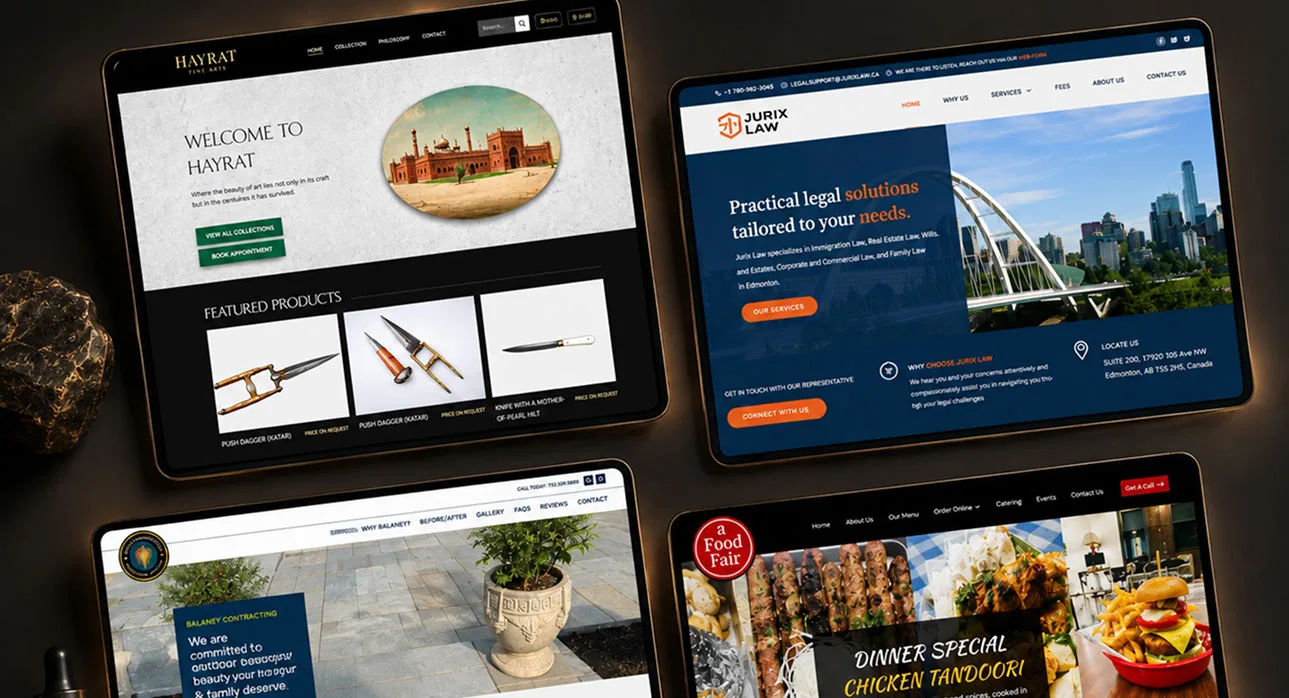
Increase in organic impressions — Balaney Contracting, first 6 months post-launch
We work with clients worldwide — NGOs, early-stage e-commerce brands, law firms, contractors, galleries, and established names in self-care and lifestyle. Our deepest experience sits in legal, construction, hospitality, and retail, where case intake, job scheduling, booking flows, and inventory decide whether software earns its keep. From technical discovery through architecture, build, and ongoing support, one accountable team handles the whole engagement so nothing gets lost between design and engineering.







10 Years of Untangling Software Complexity

React & Next.js
The interface layer behind most modern applications. We've shipped React front ends for over 10 years — still our default for dashboards, portals, and anything with real-time state. Best for interface-heavy products where responsiveness decides whether people use it.

Node.js & APIs
Our preferred backend for connected systems — REST and GraphQL APIs, webhooks, and real-time features on a single JavaScript codebase. Best for applications that integrate several third-party services or handle many concurrent users.

Laravel & Django
Mature, batteries-included frameworks with authentication, permissions, and admin tooling built in. Rapid to develop against and straightforward for other teams to maintain. Best when business logic is complex and time to first release matters.

Cloud-Native
Containerised deployment on AWS or your existing cloud, with managed databases, automated backups, and infrastructure defined as code. Scales with demand and needs ongoing DevOps attention. Best for high-traffic products with growth ahead of them.
The Work We're Proud to Show Off
- Testimonials
Every Project Starts With Trust

"WebBirds are truly artistic geniuses in action. Our experience collaborating with them was nothing short of extraordinary, and the outcomes exceeded our expectations."
“Everything is in one place, which is a lot easier than working with disparate mockups and prototypes.”
- Our Delivery Process
Our Development Process, Week by Week
A 12-week engagement, phase by phase. Real dates flex with scope — but this is the shape of every WebBirds application project.
01
Discovery
wk 1-2 — Process mapping, data model, and agreed success metrics
02
Design
wk 2-4 — User flows, UI design, and a documented component library
03
Development
wk 4-8 — APIs, database, and application logic built in staging
04
Integration
wk 6-10 — CRM, payments, and third-party systems wired and tested
05
QA
wk 6-11 — Functional, security, and load testing against real data
06
Launch
wk 11-12 — Deployment, team training, and 30 days of monitoring
WEEK 1
WEEK 6
WEEK 12
Web Application Development: Frequently Asked Questions
Everything you need to know before starting an application project — timelines, technology choice, security, integrations, and ownership. Clear answers to the questions we're asked most, with no vague agency hedging.
Can't find your answer?
If you have questions or need more details, feel free to reach out.
01 What is a web application?
A web application is software that runs in a browser and lets users perform tasks — logging in, entering data, running reports, completing transactions. Unlike a website, which mainly presents information, a web application processes it. Client portals, booking systems, dashboards, and SaaS products are all web applications.
02 What's the difference between a website and a web application?
A website delivers content; a web application delivers functionality. Websites are read-mostly and measured by traffic and conversions. Applications have user accounts, databases, permissions, and business logic, and are measured by adoption and time saved. If users log in and change data, you need an application.
03 How long does it take to build a web application?
Most custom web applications take 12 to 24 weeks. A focused MVP with one core workflow runs 8–12 weeks; a multi-role platform with integrations runs 16–24 weeks; enterprise systems run longer. WebBirds engagements typically run 12 weeks across six phases. The most common delay is unclear requirements, not development.
04 Which technology stack should I choose?
Choose React with Node.js for interface-heavy, real-time products on one language. Choose Laravel or Django when business logic is complex and you want faster time to first release. Choose cloud-native containers when traffic is high and growing. We recommend a stack after discovery, based on your team and roadmap.
05 Should I build custom software or buy an off-the-shelf tool?
Buy off-the-shelf when your process is standard — accounting, email, basic CRM. Build custom when the process is your competitive advantage, when licence costs scale painfully with headcount, or when your team maintains spreadsheets to work around the tool you already pay for. We’ll tell you honestly which applies.
06 Can you integrate with the systems we already use?
Yes. We build against documented APIs for CRMs like Salesforce and HubSpot, payment processors including Stripe, accounting platforms, ERPs, and identity providers for single sign-on. Where no API exists, we use secure file exchange or scheduled syncs. Integration requirements are confirmed during discovery, before scope is locked.
07 How do you keep our application and its data secure?
Every build uses encrypted connections and encrypted data at rest, role-based access control, input validation against OWASP Top Ten risks, and audit logging on sensitive actions. Dependencies are patched on a schedule and environments are separated. For regulated industries, we align with your compliance requirements during discovery.
08 Do I own the source code and infrastructure?
Yes to both. You own the repository, the source code, the design files, and all hosting, database, and domain accounts — no proprietary lock-in and no licence tied to us. At handover you receive documentation, environment setup instructions, and a runbook so another team can take over without archaeology.
09 What happens after launch — do you provide ongoing support?
Every launch includes 30 days of monitoring and fixes. After that, most clients move to a support agreement covering uptime monitoring, security patching, backups, and a set number of development hours each month for iteration. You can also take support in-house — the documentation is written for that.
10 Can the application scale as our user base grows?
Yes, when it’s architected for it from the start. We design database schemas and API layers to handle growth, use caching and background job queues for heavy operations, and deploy on infrastructure that scales horizontally. We load-test against projected volumes before launch so limits are known, not discovered.
Let’s Build a Website That Works
Tell us what you're trying to achieve. We'll review your requirements and come back with a clear scope, a realistic timeline, and honest recommendations — including telling you if the work you're asking for isn't the work you need. No obligation.
