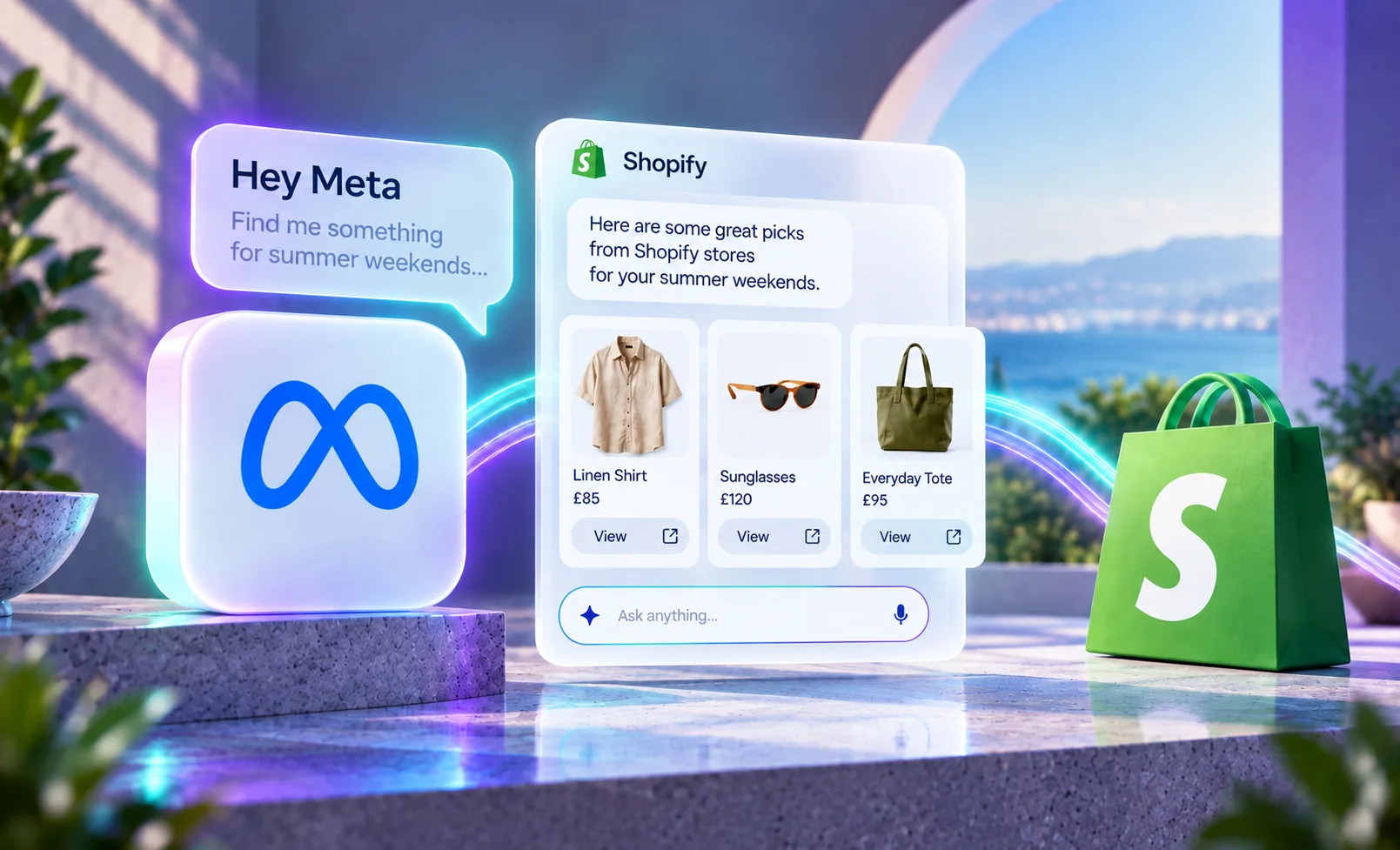
On September 22, 2026, the way people buy things online quietly changed. Shopify announced a deep partnership with Meta’s Muse AI agent that lets Muse complete purchases using Shop Pay on every Shopify store. Shopify’s founder Tobi Lutke put it plainly on X: “We are excited to announce we are partnering deeply with Muse to enable agentic checkout with Shop Pay on all Shopify stores, offering people an easy and delightful way to shop and check out with Muse.” Shopify shares climbed about 7% on the day, and, according to multiple outlets, Amazon moved to block Muse from its own marketplace around the same time. Two of the largest players in commerce just picked opposite sides of the same bet.
That split is the real story. Agentic commerce, where an AI assistant browses, compares, and buys on a shopper’s behalf, stopped being a conference talking point and became a live checkout button on millions of stores overnight.
What is agentic commerce, in plain terms?
Agentic commerce is online buying where an AI agent handles part or all of the purchase for a person. Instead of a shopper opening ten tabs, the shopper tells an assistant what they want, and the agent finds options, checks details, and completes checkout. The Shopify and Muse deal is a concrete example: a shopper talks to Muse, Muse surfaces products from Shopify stores, and the purchase closes through Shop Pay without the person ever landing on the product page in the old way.
This sits alongside a shift that started in late 2025, when OpenAI and Stripe introduced Instant Checkout inside ChatGPT using the Agentic Commerce Protocol, letting eligible merchants sell directly inside a chat. Put those together and a pattern is obvious: the checkout is moving off your website and into the assistant.
Why this matters more than a normal product update
For most of the last two decades, the job of an online store was to win the click, then win the cart. Agentic commerce changes both halves of that job.
When an AI agent is doing the shopping, your product might be chosen or skipped before a human ever sees your homepage, your hero image, or your carefully written copy. The agent reads structured data: titles, prices, availability, attributes, reviews, and shipping. If that data is thin, messy, or missing, your product is harder for the agent to recommend, and you lose sales you never knew were in play.
There is also a control question worth sitting with. When Amazon blocks an agent and Shopify welcomes it, they are making different bets about who owns the customer relationship. If the agent becomes the storefront, the brand that feeds the cleanest data and the smoothest payment path tends to win the placement. That rewards merchants who prepare and punishes those who wait.
The two paths merchants are being pushed toward
The Shopify versus Amazon divide gives store owners a useful mental model.
The open path, represented by the Shopify and Muse partnership, treats AI agents as a new sales channel to court. You make your catalog easy for agents to read and buy from, and you accept that some sales will happen inside an assistant rather than on your site.
The walled path, represented by Amazon’s block, treats agents as a threat to be controlled inside a marketplace’s own rules. That can protect margins and data in the short term, but it also cedes the emerging channel to whoever moves first.
Most independent brands do not own a marketplace, so the practical question is not whether to allow agents, it is how ready your store is when an agent shows up.
A quick self assessment: is your store agent ready?
Ask yourself these questions honestly:
- Is every product feed complete, with accurate titles, prices, stock levels, and clear attributes like size, material, and color?
- Do your product pages carry structured data (schema) so machines can parse them without guessing?
- Are your reviews and ratings visible in a format an agent can read, not locked inside an image or a script?
- Is your checkout fast, trusted, and low friction, since agents favor paths that complete cleanly?
- Do you know which AI surfaces (Shop Pay in Muse, ChatGPT, Google’s AI experiences) can already reach your products?
- If you hesitated on more than one, you have work to do, and the good news is that most of it overlaps with things that also help human shoppers and traditional SEO.
In agentic commerce, your product data is your storefront. If an AI agent cannot read it cleanly, it cannot sell it.
What to actually do in the next 30 days
Start with your data, because that is what agents consume. Audit your product feed for gaps and fix the obvious ones first: missing attributes, vague titles, out of date pricing, and broken availability signals. Clean structured data across product, review, and organization schema so machines understand what you sell and who you are. This is the same foundation that powers strong GEO (Generative Engine Optimization) and AEO (Answer Engine Optimization), which is why the work compounds.
Next, reduce checkout friction. Agents complete purchases where the payment path is trusted and quick, so a slow or clumsy checkout costs you both human and agent sales. Then map your presence across AI surfaces so you know where you already appear and where you are invisible.
If you run on Shopify, the Muse and Shop Pay connection is now part of the platform’s default fabric, so the leverage is in the quality of what you feed it, not in a single toggle.
This is exactly the kind of groundwork our team handles for clients through ecommerce solutions and technical SEO. If you want a second set of eyes on whether your store is ready for AI driven buying, that is a good place to start a conversation.
The honest caveats
A few things are worth stating clearly rather than overselling. Agentic commerce is early, and adoption numbers will move around for a while. Not every shopper wants an agent to buy for them, and trust, returns, and customer service inside agent flows are still being worked out. The Shopify and Muse rollout is significant precisely because of its scale, but scale of availability is not the same as scale of usage, and it will take time to see how many real purchases flow through it.
What is not speculative is the direction. Major platforms are building the rails for agents to shop and pay, and the merchants who make their stores easy to read and easy to buy from will be the ones agents recommend. That preparation pays off whether agentic commerce grows fast or slow, because clean data, structured pages, and a trusted checkout have never hurt a store yet.
The stores that treat this week’s news as a nudge, not a novelty, will be the ones sitting comfortably in the cart when the agents come shopping.
Frequently Asked Questions
What is agentic commerce?
Agentic commerce is online shopping where an AI agent browses, compares, and completes a purchase on a person’s behalf. The shopper states what they want, and the agent handles product selection and checkout, often without the person visiting the store’s website directly.
What did Shopify and Meta announce?
On September 22, 2026, Shopify announced that Meta’s Muse AI agent can check out using Shop Pay across all Shopify stores. Shopify CEO Tobi Lutke confirmed the partnership publicly, describing it as enabling agentic checkout with Shop Pay on every Shopify store.
Do I need to change anything if I run a Shopify store?
The Shop Pay connection to Muse is part of the platform, so you do not flip a single switch to enable it. The real work is making your product data clean and complete, adding structured data, and keeping checkout fast and trusted so agents can find and buy your products.
Why did Amazon block Muse while Shopify embraced it?
Reports indicate Amazon moved to keep Muse out of its marketplace while Shopify opened its stores to the agent. The two are making opposite bets about who controls the customer relationship: a marketplace protecting its own rules versus a platform courting a new AI sales channel.
How is this different from ChatGPT shopping?
They are part of the same trend. In late 2025, OpenAI and Stripe launched Instant Checkout in ChatGPT using the Agentic Commerce Protocol. The Muse deal extends agent driven buying to Shopify’s Shop Pay. Together they show checkout moving off your website and into AI assistants.
Will AI agents replace my website?
Not entirely, at least not soon. Agents are becoming a new channel alongside your site, email, and social. Your website still matters for brand, discovery, and trust, but you now also need to be readable and buyable inside AI surfaces.
How do I make my store ready for AI shopping agents?
Start by auditing and cleaning your product feed, add structured data across product and review schema, make sure reviews and pricing are machine readable, and streamline checkout. This overlaps heavily with GEO, AEO, and technical SEO work.