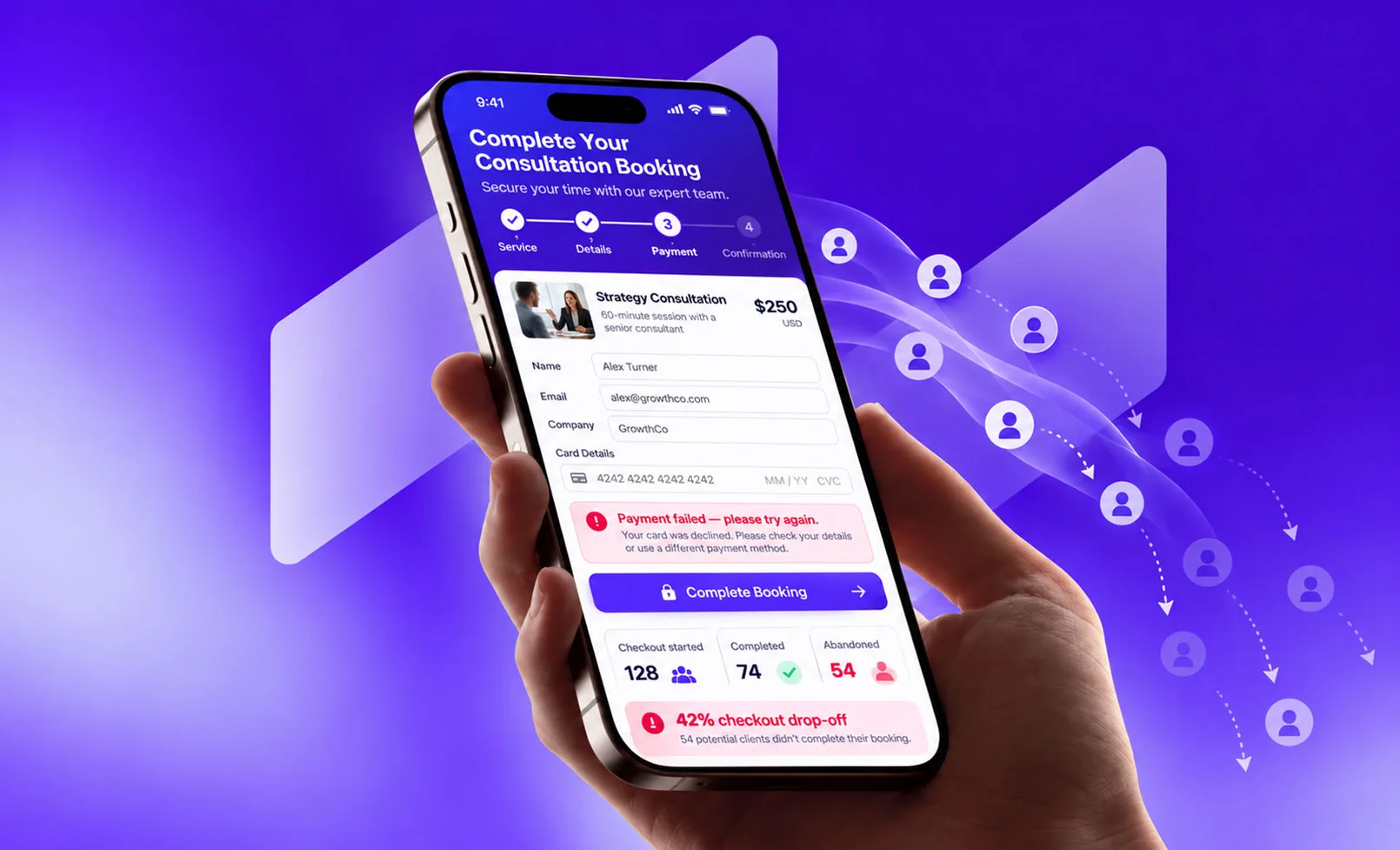
Most law firms, accounting practices, and consultancies do not think they have a checkout. They have a “contact us” form, a scheduler, maybe an invoice that goes out later. But the moment you let a prospect book a paid consultation, buy a fixed-fee package, or start a retainer from your website, you have built an ecommerce flow. And like every ecommerce flow, it leaks.
The leak is just harder to see than an abandoned shopping cart, because you never watch a number tick down in real time. You see it as “we get decent traffic, our phone rings sometimes, but we are not booking the work we should be.” That gap, between the people who showed real intent and the people who actually paid or booked, is your abandonment rate. In retail, the documented average for abandoned online checkouts sits around 70 percent, per the Baymard Institute’s long-running research. Service firms are not immune to the same friction. They just rarely measure it.
Here is where professional services firms lose the client between interest and commitment.
The form asks for a marriage before a first date
A prospect ready to book a 30 minute paid consult hits a form with fourteen fields: full legal name, company, address, matter type, budget range, how they heard about you, a 500 character description of their issue. Every extra field is a reason to close the tab. The person who was ready to pay you 250 dollars for an hour of advice decides to “think about it” and never comes back.
Fix: ask for the minimum needed to take payment and hold the slot. Name, email, the service, the time, the card. Everything else can be collected after the booking is confirmed, when the client is already committed.
No price, no path, no peace of mind
Professional services have a culture of “it depends,” and sometimes it really does. But a website that hides every number forces the prospect to call just to find out if they can afford you. Many will not call. They will assume it is expensive and move on. Meanwhile the firm that published “Trademark filing, flat 900 dollars, booked and paid online” captured the client who wanted a decision, not a discovery call.
Fix: productize what you can. Turn repeatable work into named, priced packages with a clear scope and a buy button. You keep custom quoting for complex matters, but you stop losing the straightforward, profitable, high-volume work to firms that made it easy to buy.
The payment step feels unsafe or unprofessional
A consultant sends a PayPal.me link. A law firm routes payment through a generic form that throws a scary browser warning. An accountant asks clients to “mail a check or Venmo.” Each of these plants a seed of doubt at the exact moment trust matters most. For regulated professions, there is an added layer: trust accounting and compliance rules mean the wrong payment setup is not just unprofessional, it can be a violation.
Fix: use a payment experience that looks like it belongs to your brand and meets your industry’s rules. For many firms that means a proper processor such as Stripe or a profession-specific option, embedded in your own site with your own branding, SSL secured, and configured correctly for things like legal trust accounts. The payment page should feel like the natural last step of a professional engagement, not a detour to a third party.
Booking and payment live in separate worlds
The prospect books a time on one tool, then gets a separate email asking for payment, then a third message with an intake form. Every handoff is a chance to lose them, and every disconnected tool is a chance for a double booking, a missed payment, or a no-show. Professional buyers read that friction as disorganization, and disorganization is the one thing they will not tolerate from someone they are about to trust with their money or their legal exposure.
Fix: connect scheduling, payment, and intake into one flow on your site. Book the time, take the deposit or full fee, and trigger the intake automatically. One path, one confirmation, one calendar hold. This is where [custom web development](https://webbirds.us/services/web-development/) and smart [automation](https://webbirds.us/services/digital-ai-services/) pay for themselves quickly, because the flow runs without your team babysitting it.
Mobile is an afterthought
A managing partner checks your site from a phone between meetings. The booking widget is cut off, the payment field will not accept a tap, the confirmation never arrives. Half of your serious prospects are deciding on mobile, and a flow that only works on desktop is a flow that only works for half your market.
Fix: test the entire path on a real phone, as a real client, with a real card. If you cannot book and pay for your own service on your phone in under two minutes, neither can they.
How to find your own leaks this week
You do not need enterprise analytics to start. Run this quick audit:
- Open your own site on your phone and try to book and pay for your most common service. Time it. Note every hesitation.
- Count the fields on your intake or booking form. Then cut the ones you do not need before taking payment.
- Check whether a prospect can see a price and a buy path for at least your top two or three repeatable services.
- Confirm the payment step is branded, secure, and compliant for your profession.
- Look at your last 30 “almost” clients. Where did each one stall: the form, the price, the payment, the follow up? Patterns show up fast.
Fixing these is not about turning a law firm into Amazon. It is about removing the small frictions that cause a ready-to-buy professional to pause, because a professional who pauses usually does not return. The firms winning the straightforward, profitable work right now are the ones that made saying yes feel effortless and safe.
If your traffic is fine but your booked work is not keeping pace, the problem is almost never “we need more visitors.” It is the flow between the visitor and the payment. That is a fixable, measurable, high-return problem, and it is one of the fastest wins available to a professional services firm this year.