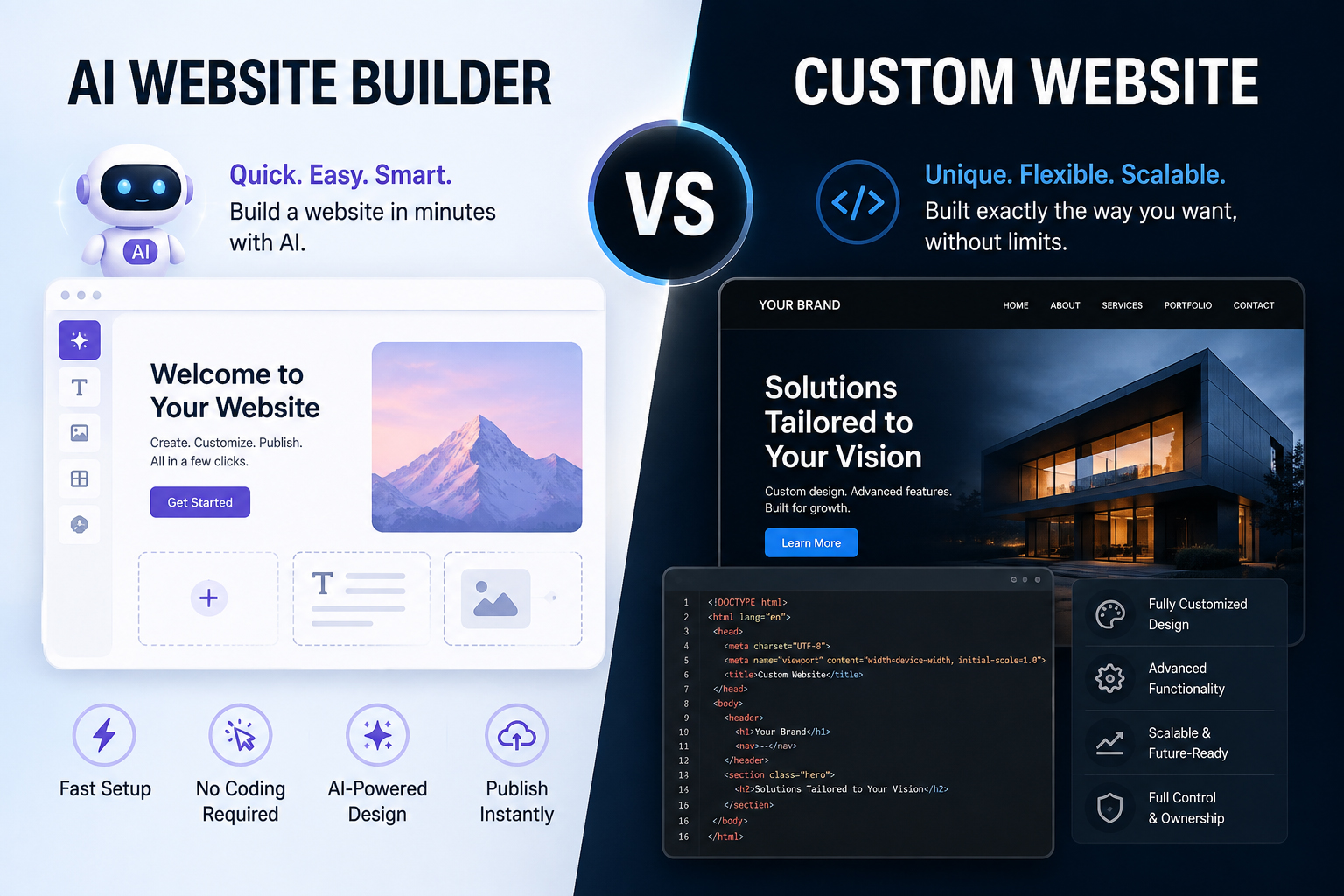
The pitch is hard to ignore. Describe your business in a sentence, wait a minute, and an AI hands you a finished website. Wix went all in on this with Harmony, its flagship AI website builder launched on January 21, 2026, and it is not alone. Framer, Hostinger, and a wave of others now promise to turn weeks of work into minutes.
Some of that promise is real. The rest of it is where businesses get burned. Here is the honest version of when an AI website builder is the right call and when a custom build earns its cost, based on what actually happens after the exciting first draft.
What AI website builders are genuinely good at now
They have improved fast, and pretending otherwise is out of date. In 2026 a good AI builder will produce a clean, responsive layout, write passable starter copy, generate or source images, wire up a contact form, and get you something live in an afternoon. For the right situation that is a strong deal.
The right situation looks like this: you need a presence quickly, your requirements are standard, your budget is tight, and you are comfortable being one of many sites that share the same underlying patterns. A local service business validating an idea, a solo consultant who needs a credible home base, a pop up campaign that will be gone in three months. In all of those, speed and cost matter more than differentiation, and an AI builder is the sensible tool.
Where the AI builder story quietly falls apart
The demo always looks great because the demo is the easy 80 percent. The trouble shows up in the 20 percent that decides whether a website actually grows a business.
Everything looks a little the same. AI builders learn from patterns, so they produce patterns. Your site ends up looking like a competent version of everyone else’s. In a crowded market, “competent and generic” does not win the click or the trust.
You do not fully own the foundation. Most AI builders lock you into their platform. Your site, your data, and your ability to move it live inside their ecosystem and their pricing. When you outgrow the template or the platform changes terms, migrating is painful and sometimes not really possible.
Performance and structure are out of your hands. AI builders optimize for looking good in the editor, not for lean code, clean structure, and the technical SEO and Core Web Vitals work that decide whether you rank and convert. You often cannot get under the hood to fix what you cannot control.
Custom logic hits a wall. The moment you need something specific, a real booking system, a gated client portal, a quote engine, an integration with your CRM or billing, an AI builder tends to shrug. It is built for the common case, and your competitive advantage is usually the uncommon case.
Compliance and trust get shaky. This is sharp in regulated fields. A financial advisory firm, an insurance agency, or a healthcare provider often has accessibility, security, data handling, and disclosure requirements that a generic AI build does not natively meet. Getting those wrong is not a design flaw, it is a liability.
The comparison, side by side
| Factor | AI website builder | Custom website |
|---|---|---|
| Time to launch | Hours to days | Weeks |
| Upfront cost | Low | Higher |
| Uniqueness | Template patterns | Built to your brand |
| Ownership | Platform locked | Fully yours |
| Performance control | Limited | Full |
| Custom features and integrations | Restricted | Open ended |
| Compliance and accessibility | Basic, generic | Built to your requirements |
| Best for | Speed, tight budgets, standard needs | Growth, differentiation, complex needs |
Neither column is the “right answer.” They solve different problems. The mistake is using the wrong one for your stage.
The real trap: outgrowing your builder later
The pattern we see most often is not a business that never should have used a builder. It is a business that used one, grew, and then hit the ceiling at the worst time. Traffic is climbing, a big campaign is coming, and the site cannot do the thing the business now needs, cannot be optimized properly, and cannot be moved without a painful rebuild. The AI builder that saved money in year one becomes the bottleneck in year two.
The cost you did not see was switching cost. A cheap start that traps you is not cheap. It is deferred.
A smarter way to use AI in the build process
The interesting move in 2026 is not choosing AI builder or custom. It is using AI tools within a professional build. Designers use AI to prototype layouts and explore directions in hours instead of days. Teams use AI to draft copy that a human then sharpens. Developers use AI coding assistants to move faster on clean, ownable code. You get the speed of AI and the ownership, performance, and precision of a custom build. That is the combination worth wanting.
That is roughly how we work. We use AI powered design to move fast on ideas and prototypes, then build the real thing on a foundation you own, that performs, and that does the specific things your business needs. The AI accelerates the process. It does not become the product you are stuck with.
So which should you pick?
Choose an AI website builder if you need something live this week, your needs are standard, your budget is small, and you are fine looking similar to others in your space. Choose a custom website if the site is a serious growth channel, you need to stand out, you have custom features or integrations, you operate in a regulated or trust heavy field, or you plan to scale and do not want to rebuild in a year.
If you are between those, the honest test is one question: is this website a placeholder or an engine? Placeholders can be built by AI. Engines are worth building right.
Where WebBirds fits: We help businesses decide, and then build accordingly. If an AI builder is genuinely enough for your stage, we will tell you. If you need a site that performs, converts, and grows with you, that is what we do. Either way you get a straight answer, not a sales pitch.
Frequently Asked Questions
Are AI website builders good enough in 2026?
For standard needs, yes. A good AI builder produces a clean, responsive site with starter copy and a working form in hours. The limits show up with uniqueness, ownership, performance control, custom features, and compliance. For a placeholder or a tight budget it is a strong tool. For a serious growth site it usually is not.
What is Wix Harmony?
Wix Harmony is Wix’s flagship AI website builder, launched on January 21, 2026, that generates and edits websites using AI combined with human style controls. It is one of the more capable AI builders available and is often cited as a benchmark for the current generation.
When is a custom website worth the higher cost?
When your website is a real growth channel rather than a placeholder. Custom is worth it if you need to stand out, require specific features or integrations, operate in a regulated or trust heavy field, care about performance and SEO control, or plan to scale without rebuilding in a year.
What are the biggest limitations of AI website builders?
Generic, template like results, platform lock in that makes migration hard, limited control over performance and technical SEO, an inability to handle custom logic and integrations, and weak support for accessibility and compliance requirements in regulated industries.
Can I move my site off an AI builder later?
Sometimes, but it is often difficult. Many AI builders lock your site, content, and data into their platform, so migrating can mean a rebuild. This switching cost is the hidden expense of a cheap start, and it tends to hit right when your business is growing fastest.
Should regulated businesses like finance or healthcare use AI website builders?
Usually not for their main site. These fields carry accessibility, security, data handling, and disclosure requirements that generic AI builds do not natively meet. Getting them wrong is a liability, not just a design issue, so a custom build made to those requirements is the safer choice.
Can I use AI and still get a custom website?
Yes, and that is the best of both. Professional teams use AI to prototype designs, draft copy, and speed up development, then build the real site on a foundation you own that performs and does exactly what your business needs. You get AI speed without being locked into an AI product.